Thursday, November 17, 2016

Iceland - Parting Shots

October 19, 2016

Dancing Light Posts in Keflavík


Art in the airport dedicated to Leifur Eiríksson (Leif Erickson)  (970 – c. 1020).  He was an Icelandic explorer and the first known European to have discovered North America (excluding Greenland), before Christopher Columbus.


Wall hanging in hallway of airport


Very cool sayings on windows in the airport.  Looking out the window to see the plane and jet way.


Yes, yes, yes - how lucky am I?  And...I wanna go back!


Iceland's Hringvegur (Ring Road) - Vík í Mýrdal and Reynisfjara beach

October 18, 2016

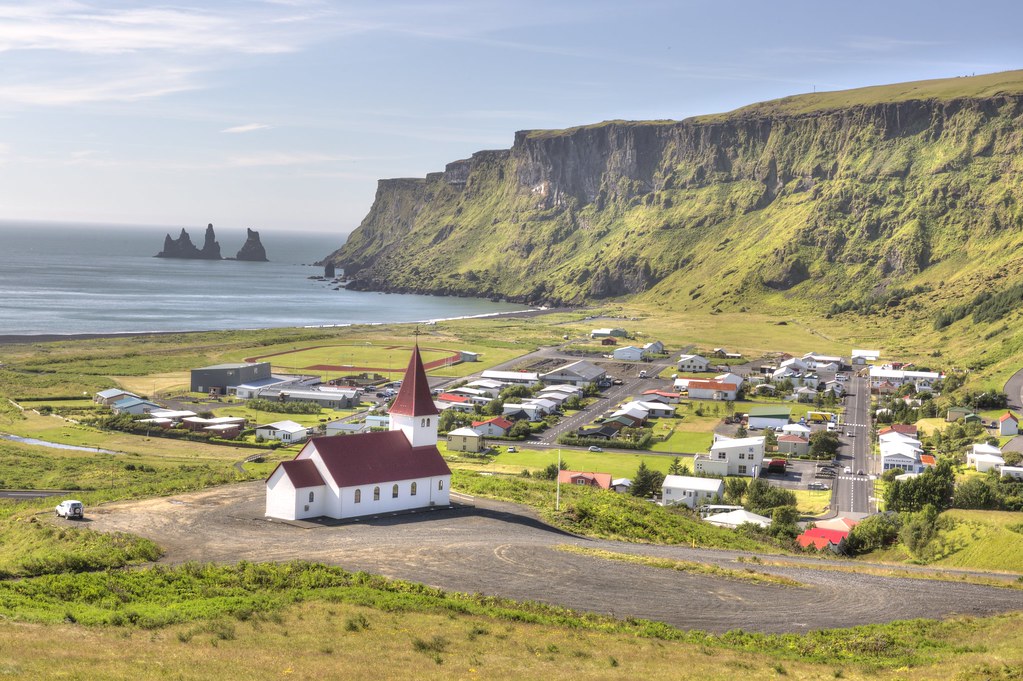
The village of Vík í Mýrdal  (aka Vík) is the southernmost village in Iceland, located on Along Þjóðvegur 1 or Hringvegur (Route 1 or the Ring Road ).  Despite its small size (291 inhabitants as of January 2011) it is the largest settlement for some 43 miles around. It is an important service center for the inhabitants of and visitors to the coastal strip between Skógar and the west edge of the Mýrdalssandur glacial out wash plain 


From the village, you can see a small outcropping of basalt rock, remnants of a once more extensive cliff line Reynisfjall.  There is no landmass between here and Antarctica so the Atlantic waves attack with full force.  They are named Skessudrangur, Langhamar and Landdrangur.  Legend says that the stacks originated when two giant trolls had tried to tow a three-sailed ship to land, but before they could reach the safety of the mountain, both the trols and the ship turned to stone.


On our way to the beach, we had to wait for some Icelandic Ram to be herded across the street.  They use ATVs to herd the rams…along with a couple of sheep dog for good measure!


In 1991, the US journal Islands Magazine named Reynisfjara beach as one of the ten most beautiful beaches on Earth. Its stretch of black basalt sand is one of the wettest places in Iceland. 

View of the basalt rock cropping from Reynisfjara  beach.


The sea around here is rather wild and stormy and so it isn't surprising that there a monument to the memory of drowned seamen on the beach.  Forgot to take a picture of the monument but managed to capture the waves.

The cliffs are home to many seabirds, most notably puffins which burrow into the shallow soils during the nesting season.  They had already migrated when we had arrived - as we were told, "they are not as brave as us to fare the Icelandic winter." 


Hálsanefshellir cave, made of columnar basalt, was used as a filming location for the movie Noah.


View from Reynisfjara Beach looking East


LOVE, LOVE, LOVE this place!


Tuesday, November 15, 2016

Iceland's Hringvegur (Ring Road) - Foss (Water Falls)

October 18, 2016

Along Þjóðvegur 1 or Hringvegur (Route 1 or the Ring Road) there are many waterfalls (foss) which are sourced by the glaciers.  We stopped at a few along the route from  Reykjavík to Vík.


The former coastline now consists of sheer cliffs with many waterfalls, of which the best known is Skógafoss. 


 Skógafoss is situated on the Skógá River and is one of the biggest waterfalls in the country with a width of 82 feet and a drop of 200 ft.


After the coastline had receded seaward (it is now at a distance of about 3.1 miles from Skógar, the former sea cliffs remained, parallel to the coast over hundreds of kilometres, creating together with some mountains a clear border between the coastal lowlands and the Highlands of Iceland.


Due to the amount of spray the waterfall consistently produces, a s rainbow is normally visible on sunny days - which we were blessed to see!  According to legend, the first Viking settler in the area, Þrasi Þórólfsson, buried a chest filled with gold coins in a cave behind the waterfall.  On fine days, when the sun is shining, people say his gold is glittering through the water.  The legend continues that locals found the chest years later, but were only able to grasp the ring on the side of the chest before it disappeared again. The ring was allegedly given to the local church. The old church door ring is now in the Skógar museum.


You can see Seljalandsfoss from the ring road but is actually a 100 metres off the road. It’s origin in the volcano glacier Eyjafjallajökull and according to the sign, “the Seljalandsa river springs up from the Seljalandsheiði and Hamragilsheiði (heaths) and passes through Tröllkonugil (Troll Woman’s gorge).   According to legend, the gorge was named such because an old troll woman was trying to cross the gorge, but had to retreat when she heard the bells ringing at the nearby Church at Asolfsskali."  I think there was something lost in translation there!  


The waterfall is 65 m high.  And, as you can kinda see here, you can walk behind Seljalandsfoss.  I didn’t because it was very cool and windy that day, so I wasn’t in the mood to get both my camera and myself wet.


We visited Seljalandsfoss later in the day, so I was able to get some longer exposure photos.  This one was f/22 with about 1/2 second of exposure. 


I wandered along the path to check out other smaller waterfalls.  They weren't labeled nor have I been able to find out much more information about them.  I like how they seem to disappear into the ground and all you see are little streams coming out lower.  Another longer exposure: f/11 and 1/3 second. 


Another little waterfall near Seljalandsfoss 

Iceland's Hringvegur (Ring Road) - Jökull (Glaciers)

October 18, 2016

Þjóðvegur 1 or Hringvegur (Route 1 or the Ring Road) is a national road in Iceland that runs around the island and connects most of the inhabited parts of the country.  We explored from Reykjavík to Vík.

Eyjafjallajökull is a volcano completely covered by an ice cap. The ice cap covers an area of about 39 sq miles and feeds many outlet glaciers. The mountain itself, a stratovolcano, is 5,417 ft at its highest point, and has a crater 1.9–2.5 mi in diameter, open to the north. 

Closer view of the glacier.  You can see a faint trace of the rainbow on the right side of the picture.  

Picture of a plaque at the visitor center show the eruption: Eyjafjallajökull began to erupt on 14 April 2010.  A plume of volcanic ash was ejected into the atmosphere by this eruption, potentially causing a hazard for airplanes. UK airspace was closed from April 15–20, causing significant disruption, and was reopened following new guidelines about ash densities that could be tolerated by aircraft.

Tee shirt seen in almost every gift shop in Iceland.


Mýrdalsjökull (mire valley glacier) is to the north of Vík í Mýrdal and to the east of Eyjafjallajökull. 


The icecap of Mýrdalsjökull covers an active volcano called Katla. The caldera of the volcano has a diameter of 6 miles and the volcano erupts usually every 40–80 years. The last eruption took place in 1918. Scientists are actively monitoring the volcano, particularly after the eruption of nearby Eyjafjallajökull began in April 2010


Monday, November 14, 2016

Iceland - Chasing the Aurora Borealis

October 17, 2016

The Aurora Borealis are the result of electrons colliding with the upper reaches of Earth’s atmosphere. The electrons are energized through acceleration processes in the downwind tail (night side) of the magnetosphere and at lower altitudes along auroral field lines. The accelerated electrons follow the magnetic field of Earth down to the Polar Regions where they collide with oxygen and nitrogen atoms and molecules in Earth’s upper atmosphere. In these collisions, the electrons transfer their energy to the atmosphere thus exciting the atoms and molecules to higher energy states. When they relax back down to lower energy states, they release their energy in the form of light


It was cloudy when we visited so we had to travel to a spot where we had a clear view of the sky.  Seen here is the big dipper and very faint beginning of the aurora.
In order to capture the light, I had to use a tripod because my exposure setting was around 10-13 seconds (varied it throughout the sequence).  This is why we can see more stars in the sky in this picture.

I love this shot because you can see the dipper outline, the lights and a shadow of a person in the fore ground.  The lights in the previous 2 shots were a static band of light.  But as seen here, the solar flares were particularly strong that night (how blessed am I???) and they became a dancing curtain of ever-changing color


I like the way this one folds, it gives you an idea of how they moved.  Shorter exposure.


A longer exposure ~ 15 seconds

Full curtain of light that was dancing across the sky - it was so amazing!  About a 10 second exposure here.  


And now it gets cool because we saw what some will chase for.... the reds and violets!! You see, typically, when the particles collide with oxygen, yellow and green are produced. But it is interactions with nitrogen that produce red, violet, and occasionally blue colors, which is more rare.

Yellows, greens and some red in this one.  Shorter exposure (note the brightness of the star) but at this time the lights were seriously bouncing about - thus all the color and movement seen.

Dancing curtain with reds - longer exposure.
I love this one.  It some how captures the movement of the auroras and the spectacular view of sky...and the pesky clouds on their way in to end our show!  See the crystal clear dots of light...proof that the camera didn't move - so all the movement you see in the sky is truly the lights!


Wednesday, November 9, 2016

Iceland's Golden Circle - Gulfoss and the road along the way

October 17, 2016

The Golden circle has many beautiful views along the route.

Another view of Lake Þingvallavatn


Along the route, there were several locations where the Icelandic horse could be seen at fences along the side of the road. 


The Icelandic horse is a breed of horse developed in Iceland. Although the horses are small, at times pony-sized, most registries for the Icelandic refer to it as a horse

Icelandic horses are long-lived and hardy. In their native country, they have few diseases. Icelandic law prevents horses from being imported into the country and exported animals are not allowed to return

A blonde, a brunette and a red head, went into a field.....


The last attraction along the Golden Circle was Gulfoss (Golden Falls).  It is located in the canyon of the Hvítá (White) river which is fed by Iceland´s second biggest glacier, the Langjökull.  It is 105’ high and has 2 drops


The story of Gullfoss is as follows:
Sigríður Tómasdóttir, the daughter of Tómas Tómasson who owned the waterfall in the first half of the 20th century, lived at a farm nearby and loved Gullfoss as no one else.

At this period of time much speculation about using Gullfoss to harness electricity was going on. Foreign investors who rented Gullfoss indirectly from the owners wanted to build a hydroelectric powerplant, which would have changed and destroyed Gullfoss forever.

As the story goes it's thanks to Sigríður Tómasdóttir that we still can uplift ourself with the beauty of Gullfoss, because she was the one that protested so intensly against these plans by going as far to threat that she would throw herself into Gullfoss and therby kill herself.

To make her threat believable she went barefoot on a protest march from Gullfoss to Reykjavik. In those days the roads weren't paved and when she arrived after 120 kilometers her feet were bleeding and she was in very bad shape.

The people believed her and listened and the powerplant at Gullfoss was never built.
Today one can see the memorial site of Sigríður that decipts her profile at the top of the falls


On the way back, we came across another fissure which was located at the other end of Þingvellir National Park


 This is a pretty good view of the following:  As the plates moved apart, excessive eruptions of lava constructed volcanoes and filled rift valleys. Subsequent movement rifted these later lava fields, causing long, linear valleys bounded by parallel faults


At some places, the fissures seemed quite scary.  You couldn't see the bottom  - so it looked like you could fall in and possibly not come out!  It was really hard to photograph that and convey the feeling.


As the "golden hour" came upon us, the views of the Lake and surrounding area were stunning.


Had to collect the 3 layers of "Jesus Rays" for Claudia!  We shall have them in our pocket for when we need them!